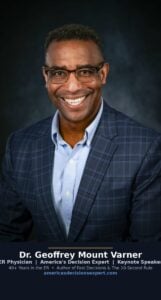
By Dr. Geoffrey Mount Varner, MD, MPH — America’s Decisions Expert
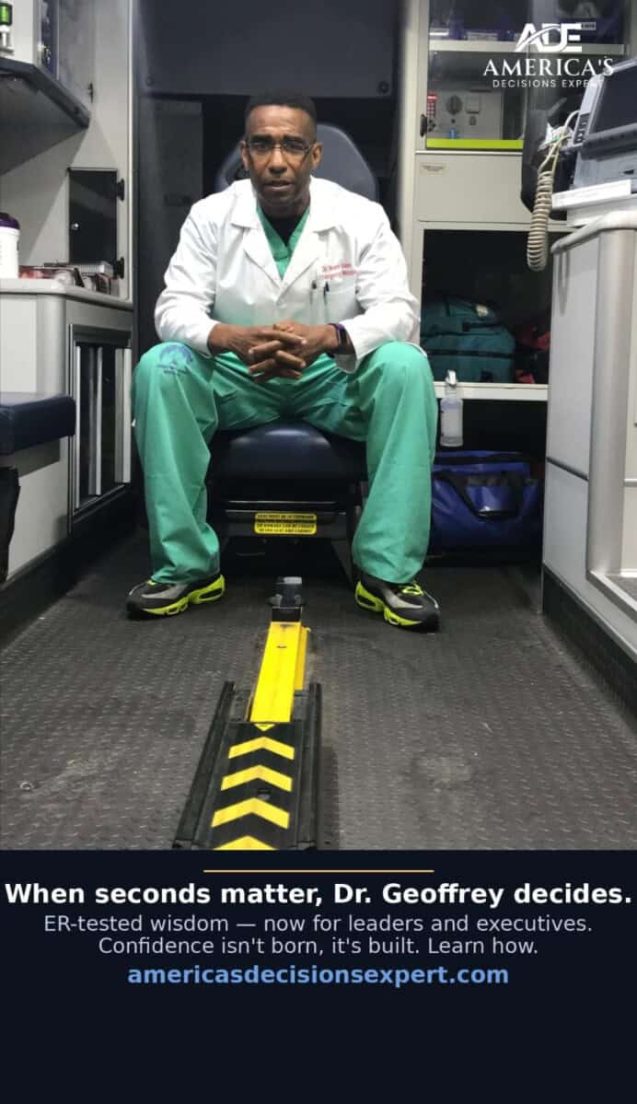
There is a moment every emergency room physician knows well: the moment when you have enough information to act, but not enough to be certain. Wait for certainty, and the patient’s condition worsens. Act now, and you may be wrong but you may also save a life. Over 40 years in the ER, I learned that leaders who wait for certainty before deciding are not being careful. They are simply choosing a different kind of risk: the risk of doing nothing.
This is the single biggest difference I see between average leaders and exceptional ones, whether I’m speaking to hospital administrators, Fortune 500 executives, or sales teams under quarterly pressure. It is not intelligence. It is not access to better data. It is the willingness to decide and move while others are still waiting for a certainty that will never fully arrive.
Certainty Is a Luxury Most Leaders Never Get
In medicine, we are trained to act on probabilities, not guarantees. A patient presents with symptoms that could indicate three or four different conditions. There is rarely time to run every test and rule out every possibility before treatment must begin. The skill is not eliminating uncertainty it’s making sound decisions inside it.
Business leadership works exactly the same way, though most leaders were never taught to see it that way. A market shifts, a competitor moves, a key employee resigns and leaders are expected to respond with confidence, using information that is incomplete by definition. Waiting for a complete picture is not leadership. It’s a delay dressed up as diligence.
Why Speed Often Beats Perfection
I’ve watched physicians early in their careers freeze at the bedside, searching for the “perfect” diagnosis before acting. The best physicians I’ve trained learned instead to make a strong working decision, act on it, and adjust as new information arrived. That approach decide, act, reassess outperforms “wait until certain” almost every time, because circumstances rarely hold still long enough to reward the wait.
Leaders who internalize this stop treating fast decisions as reckless and start treating them as disciplined. There is a real difference between a fast decision and a reckless one: a fast decision is made with the best available judgment and a clear framework; a reckless one is made with no framework at all. Audiences consistently tell me this distinction changes how they operate it gives them permission to move quickly without mistaking speed for carelessness.
A Framework for Deciding Without Full Certainty
The framework I share on stage refined over thousands of real, high-stakes decisions comes down to three questions I teach leaders to ask before any major call:
What is the cost of waiting, not just the cost of being wrong? Most leaders only weigh the risk of a bad decision. They rarely weigh the compounding cost of delay lost time, lost opportunity, lost trust in their leadership.
What is the smallest decisive action I can take right now? Big decisions feel paralyzing. Breaking them into the next decisive step not the entire five-year plan restores momentum.
Am I waiting for more information, or am I waiting to feel less afraid? These are often mistaken for each other. More data rarely resolves fear. Only action does.
Why This Resonates With Audiences
When I deliver this message on stage, it lands differently than typical leadership content, because it isn’t theoretical it comes from a career where indecision had immediate, visible consequences. Audiences don’t just hear a framework; they hear it from someone who has lived its stakes in the starkest possible terms, in the emergency room and, later, through surviving cancer three times.
That authenticity is what event organizers tell me they’re looking for in a decision-making keynote speaker: not another abstract leadership model, but a speaker whose framework has been tested where the cost of hesitation was real. It’s a message that resonates equally with healthcare leadership audiences, executive teams, and sales organizations anyone whose success depends on deciding well under pressure, not deciding perfectly.
The Takeaway for Leaders
Certainty is not coming. The leaders who understand this stop postponing decisions in search of it, and start building the confidence and framework to decide well without it. That shift from waiting for certainty to acting with disciplined confidence is, in my experience, the single most valuable thing a leadership audience can walk away from a keynote with.
Share this post