
Is this you? Or do you exclusively represent this speaker?
Claim Your Speaker Profile
Why Claim Your Profile?
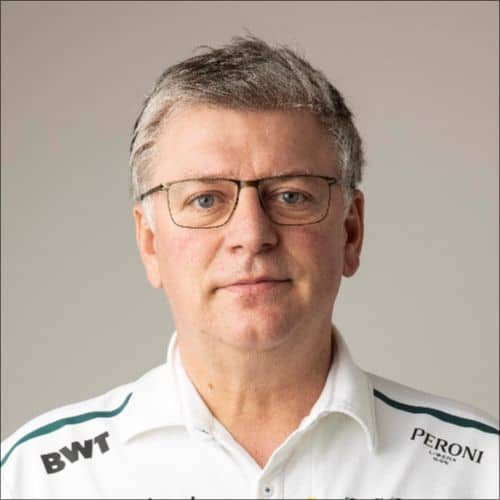
Otmar Szafnauer
About
Engagement Types
Table of Contents
Biography Highlights
- Former CEO and Team Principal of the Aston Martin F1 team, Otmar is a highly accomplished motor racing executive with over three decades of leadership experience in Formula 1. He first came to prominence in his role as Vice President of Honda Racing. Otmar was with Aston Martin for 12yrs and was instrumental in their success. His most recent role in Formula 1 was as Team Principal of the Alpine F1 Team until mid-2023. Born in Romania, Otmar grew up in the USA (working for the Ford Motor Company). Outside of F1, Otmar is chairman of successful software company, Soft Pauer.
Biography
With a career spanning over 30 years, Otmar Szafnauer has held several high-profile roles, including VP of Honda Racing, CEO and Team Principal of Aston Martin Racing and most recently, Team Principal of the Alpine F1 Team.
Renowned for his technical industry knowledge, empathetic leadership and guiding teams through complex challenges. Otmar’s experiences provide key insight into leading through change, building cohesive teams and making high-stakes decisions, offering audiences a masterclass in strategic leadership.
Expertise
Leadership at Honda Racing: As Vice President of Honda Racing Development, Otmar became a key advisor, leading regulatory and commercial negotiations with the FIA and other stakeholders. He also chaired the Engine Manufacturers Working Group, collaborating with major OEMs, including Renault, BMW, Mercedes, Ferrari, Toyota, and Honda, to shape F1 engine regulations.
Transforming Force India: In 2009, Otmar joined Force India as Chief Operating Officer, transforming the team from a struggling competitor to a consistent top-four finisher in the World Championship. His focus on high performance and psychological safety helped create a culture that retained all employees through financial administration and a successful team sale.
Success with Racing Point and Aston Martin: After leading Force India through administration, Otmar became Team Principal and CEO of Racing Point, guiding the team to victory at the 2020 Bahrain Grand Prix and a 4th place finish in the Constructors’ Championship. He continued his role as CEO when the team was rebranded as Aston Martin, driving further success and recruiting key talent, including 4-time World Champion Sebastian Vettel.
Leading Alpine F1 Team: As Team Principal of the Alpine F1 Team, Otmar led the team to its highest-ever finish in the World Championship, implementing cultural changes and strategic shifts that strengthened its competitive standing.
Expertise and Insights in Motorsport: Throughout his career, Otmar has consistently demonstrated an ability to lead through change, build winning teams and drive innovation in a high-pressure environment. He brings unparalleled insights on leadership, team dynamics, and unique insights from one of the world’s most competitive and high-profile sports.
Speaker Topics – Keynote or Fireside Chat
- Leadership and Team Dynamics: Strategies for cultivating high-performing teams.
- Strategic Management: Insights from managing operations and navigating high-stakes environments.
- Innovation in Automotive Engineering: The role of cutting-edge technology and forward-thinking strategies in driving competitive success.
Videos
Media, podcast appearances and interviews
Popular Talks
Leadership
The requirements of Formula One’s team leaders have changed significantly in recently years as teams have become larger, more complex, and the business model to which the sport operates has been transformed. The leaders in F1 today are responsible for leading up to 1800 full time employees, creating a high-performance organisation which is fully aligned behind a strategy aimed at achieving a set of well defined, ambitious goals.
Competitive team leaders create a culture in which team personnel take responsibility and are happy to be held accountable for their performance. Developing a high degree of psychological safety is key, requiring staff to speak up and speak out, with strong cross functional communications. A relentless focus on continuous improvement is part of the F1 leaders mindset, and teams take a data-driven approach to measuring performance, highlighting issues and analysing developments. But whilst F1 is a technocentric sport, the successful leaders recognise that it is the people who make a difference. This is why so much effort is deployed to create an environment within which employees thrive, using their combined talents to problem solve and create highly innovative solutions in order to drive competitive advantage.
Teamwork/Collaboration
Competitive Formula One teams comprise 1800 staff, less than 10% of whom attend the race events, so teamwork requires complete alignment, shared purpose and close collaboration across the business. The world championship includes 24 Grands Prix and these represent a series of non-negotiable deadlines which the entire organisation has to meet in terms of car development, hardware and software upgrades. The ultimate, public example of high-performance teamwork comes in the form of the mandatory pit stops which have to be performed during a race – the record now stands at 1.8 seconds during which 22 staff carry out 36 tasks under extreme pressure. Alignment behind the team’s strategies and ambitious goals is vital, so too having the agility to flex the strategy in the face of constant changes in technology and the performance of competitors.
Data-driven performance & Innovation
More than any other sport, Formula One has embraced a data-driven business culture, particularly with its near obsession with marginal gains and continuous improvement. F1 teams use data to enable drivers, engineers and HQ staff to determine precisely how the car and driver is behaving, diagnose issues, resolve problems and speed up decision making. As information flows seamlessly around the globe, linking car, team and factory, tech security is essential and robust systems ensure protection from multiple threats.
The use of simulators has transformed driver training, enabling systems to be learned, tested and developed in a virtual environment prior to real-world deployment. And with the advent of additive manufacturing, machine learning, AI and GenAI across F1, the sport’s use of technology to innovate and transform all aspects of its operations is set to accelerate further.
Safety & Risk Management
Safety is a first order priority in Formula One and the last 30 years have seen a profound change to the way in which the sport manages risk. Between 1950 and 1994, there were over 40 driver fatalities at races; there has been one since. This has been made possible by creating clear priorities as regards safety. Compliance is non-negotiable. Safety is not an area of competitive advantage. Safety systems, processes and technologies are shared so that F1 doesn’t have islands of excellence in oceans of mediocrity.
However, the risk averse teams never win in F1 – the teams which embrace and manage risk are more likely to try new things, innovate in ways both small and large, and ultimately drive competitive advantage. It’s the difference between participating and competing. The other factor is ‘fear of failure’. Teams that have a blame culture create such a degree of fear that everyone minimises their contribution and hides their mistakes, whereas those which thrive on creating a learning environment of continuous improvement have a degree of openness, honesty and transparency which promotes creativity and innovation, and taking risks, in a controlled way.
Change & Transformation
Every industry is witnessing change and Formula One is no different. One of the challenges facing F1 teams is that the sector is ever-changing – so change management and leading teams through periods of transformation is an essential part of the job. Change comes in many forms; technology, compliance, competition, customer demands, environmental and social issues. F1 has had to reinvent its business model, embrace digitalisations, adapt to a changing media and social landscape. Above all, F1’s leadership teams have had to communicate, manage and implement transformation strategies, bringing their teams with them and ensuring that they make the most from embracing change.
Speaker Bureaus and Talent Agencies

